Chaga Tea Health Benefits: What the Research Really Shows
What chaga tea is, what research says about its antioxidant and immune-related benefits, plus side effects and how to brew a cup at home.

In this guide · 7 sections
Chaga is a dark, hard fungus that grows on birch trees in cold climates and has been used in traditional Russian and Northern European medicine for centuries. Brewed as tea, it's valued mainly for its antioxidant content, though many of its more dramatic claimed benefits go well beyond what current research supports.
What Is Chaga?
Chaga (Inonotus obliquus) grows as a hard, charcoal-like mass on birch bark, absorbing nutrients from the tree over years. It's classified by some as an adaptogen, a category of substances traditionally believed to help the body respond to stress, though the scientific evidence for adaptogens in general is still limited. Chaga has been used in Chinese and Russian folk medicine for centuries and has more recently become popular in the West as a tea and supplement.
What's in Chaga?
Chaga contains polysaccharides (complex carbohydrates), B-glucans, triterpenes and betulinic acid, along with smaller amounts of B vitamins, potassium, zinc and other minerals. Its dark color comes from melanin, the same pigment-related compound found in human skin.
Potential Benefits of Chaga Tea
Most research on chaga so far comes from lab and animal studies, with human research still limited. Here's what's been studied.
Antioxidant Properties
Chaga's melanin and triterpenoid content give it strong antioxidant activity in lab studies, meaning it may help the body manage oxidative stress from everyday exposures like sun and pollution.
May Support Immune Function
Chaga's beta-glucans are being studied for their effects on the immune system. Some lab and animal research suggests chaga extract may help modulate immune response and reduce markers of inflammation, though this hasn't been well established in humans. See our roundup of teas that support immunity for other options.
May Support Blood Sugar Balance
A small number of lab and animal studies suggest chaga extract may help lower blood sugar markers, and Memorial Sloan Kettering notes it can have an additive effect when combined with diabetes medications. If you have diabetes or take blood sugar medication, talk to your doctor before using chaga regularly, since it may interact with your treatment.
Digestive Support
Chaga has traditionally been used to support digestion, and some research points to mild anti-inflammatory effects that may help with digestive discomfort. Compounds like triterpenoids have shown anti-inflammatory effects in lab research, which is one reason chaga is sometimes used as a complementary approach for joint or muscle discomfort too, not a substitute for medical treatment. It is not a treatment for gastritis, ulcers or other diagnosed digestive conditions; if digestion is your main concern, see our list of teas for gut health.
Stress Support
Some traditional use suggests chaga may have a mild calming effect, which fits its classification by some as an adaptogen. Robust human studies on this are lacking, so treat it as a nice-to-have rather than a stress remedy.
Cancer Research (Preliminary)
Some lab studies have looked at compounds in chaga, including betulinic acid, for their effects on cancer cells in a dish. Memorial Sloan Kettering confirms this research is preclinical only, with no human clinical trials showing chaga treats or prevents cancer. Anyone undergoing cancer treatment should talk to their oncologist before adding any herbal supplement, since some can interact with chemotherapy or radiation.
Chaga Tea Side Effects and Precautions
Chaga can increase the risk of bleeding, particularly for people taking blood thinners like warfarin, since lab research shows it inhibits platelet aggregation. It may also lower blood sugar, which can be risky if combined with diabetes medication like insulin. Case reports have also linked heavy, long-term chaga powder intake to kidney damage from its high oxalate content. Because of these interactions, talk to your doctor before drinking chaga regularly if you:
- Take blood-thinning or diabetes medication
- Are pregnant or breastfeeding
- Have a kidney condition, since chaga is high in oxalates
- Are undergoing cancer treatment
How to Brew Chaga Tea
- Heat water to about 175°F (80°C); chaga doesn't need boiling water.
- Use one chaga tea bag or a small piece of dried chaga per cup.
- Cover and steep for 5–10 minutes; chaga can also be simmered longer for a stronger brew.
- Remove the tea bag or strain, and enjoy. Chaga has a mild, earthy flavor with light notes of wood and vanilla, and no caffeine.
Chaga Latte: brew a cup of chaga tea as above, then stir in your milk of choice and a sweetener. A dash of cinnamon or nutmeg is a nice addition. Chaga powder can also be stirred straight into smoothies.
Related guides: how to make mushroom tea and reishi tea.
FAQ
Does chaga tea have caffeine?
No. Chaga tea is naturally caffeine-free, which is part of why it's often used as a coffee alternative.
Can chaga tea cure cancer?
No. Chaga is not a treatment or cure for cancer. Some of its compounds are being studied in labs, but this is preliminary research, not medical evidence for treating disease in people.
How much chaga tea is safe to drink daily?
Many sources suggest 1–2 cups a day, but talk to your doctor first if you have diabetes, a bleeding disorder, or kidney issues.
Is chaga tea safe to drink every day?
For most healthy adults, moderate daily consumption appears to be well tolerated, but anyone on blood thinners, diabetes medication or with kidney concerns should check with their doctor first.
The Bottom Line
Chaga tea is a caffeine-free, antioxidant-rich brew with a long history in traditional medicine, and some of its compounds show promise in early lab research. That said, it isn't a proven treatment for any disease, and its potential to interact with blood thinners and diabetes medication means it's worth a quick conversation with your doctor before making it a daily habit.
Free printable
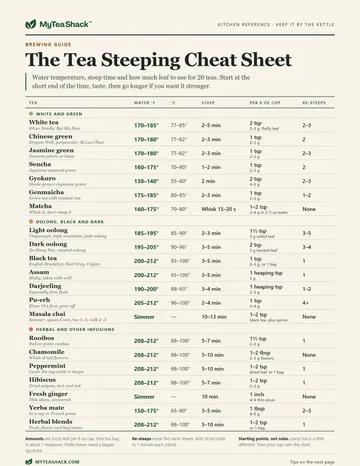
The Tea Steeping Cheat Sheet
Water temperature, steep time and how much leaf to use for 20 teas, from sencha to rooibos, on one printable page. Plus five fixes for a bitter cup.