How Tea Is Made: From Leaf to Cup
How tea is processed from harvest to your cup, ideal brewing temperatures and times by type, and tips for using tea bags or an infuser.
In this guide · 7 sections
Tea isn't one-size-fits-all: different types need different water temperatures and steep times to taste their best. Brew too hot or too long, and even good tea turns bitter and astringent.
Basic Steps for Brewing Any Tea
- Choose the right tea for the occasion and gather your tools: kettle, infuser or tea bag, a timer, and ideally a thermometer.
- Measure out the right amount of tea (usually about 1 teaspoon of loose leaf per cup).
- Warm your teapot or cup briefly with hot water, then discard it — this keeps the tea from cooling too fast once brewed.
- Heat water to the correct temperature for your tea type (see the table below).
- Pour the water over the leaves or bag and let it steep for the recommended time.
Brewing Temperatures and Times by Tea Type
The water temperature and steep time matter more than most people realize. Water that's too hot, or a steep that runs too long, pulls out excess tannins and makes tea bitter.
| Tea type | Water temperature | Steep time |
|---|---|---|
| White | 167–185°F | 3–5 minutes |
| Green & yellow | 150–176°F | 1–2 minutes |
| Oolong | 167–203°F | 5 minutes |
| Black | 167–194°F | 3–4 minutes |
| Cooked pu-erh | 203°F | 5 minutes |
For a deeper dive into specific types, see our guides on how to make green tea and how to brew herbal tea.
A Brief History of the Tea Bag
The tea bag was actually an accident. Around 1908, American tea merchant Thomas Sullivan began mailing tea samples to customers in small silk bags meant only as packaging. Customers started steeping the bags whole instead of opening them, and the idea caught on — first in the United States in the 1920s, and later in the United Kingdom, where loose leaf tea had long been the standard.
How to Brew Tea With a Bag
Tea bags are convenient and pre-portioned, though loose leaf generally gives a fuller flavor since the leaves have more room to unfurl.
- Boil water and pour it over the tea bag in a cup.
- Cover the cup to trap aroma and heat.
- Let the bag steep for 3–5 minutes depending on your preferred strength: about 3 minutes for a light cup, 4 for medium, and 5 for a strong, bolder brew.
- Remove the bag (or leave it in if you like it stronger).
Tips: Use filtered or bottled water for the best taste, and ceramic or porcelain cups to help retain heat.
How to Brew Tea With an Infuser
- Heat water to the temperature suited to your tea type — avoid a rolling boil for delicate teas like green or white.
- Add about 1 teaspoon of loose leaf per 3.5 oz of water to the infuser.
- Pour the hot water over the leaves and let steep for the recommended time.
- Remove the infuser once steeping is done.
- Add milk, honey, sugar, or a squeeze of lemon if you like — though many teas, especially green and white, are best enjoyed plain.
FAQ
Why does my tea taste bitter?
Bitterness usually comes from water that's too hot or a steep time that's too long, both of which over-extract tannins from the leaf.
Is loose leaf tea better than tea bags?
Loose leaf generally offers fresher flavor since whole or large leaf pieces have more surface area to unfurl, but quality tea bags can still make a good cup. See our comparison of loose leaf vs. tea bags for more detail.
Can I reuse tea leaves or a tea bag for a second steep?
Many whole-leaf teas, especially oolong and pu-erh, can be steeped multiple times, often revealing different flavor notes with each infusion. Most bagged tea is cut too fine for a good second steep.
The Bottom Line
Great tea comes down to matching water temperature and steep time to the type of tea you're brewing. Get those two variables right, whether you're using a bag or loose leaf, and you'll avoid the bitterness that ruins an otherwise good cup.
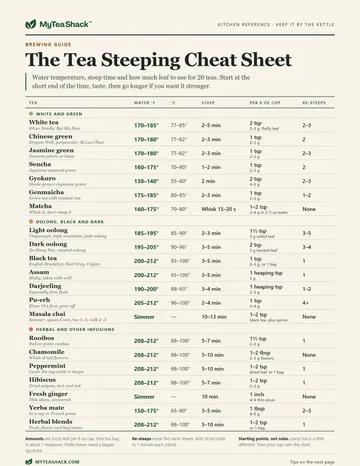
Free printable
The Tea Steeping Cheat Sheet
Water temperature, steep time and how much leaf to use for 20 teas, from sencha to rooibos, on one printable page. Plus five fixes for a bitter cup.