How to Make Boba (Bubble Tea) at Home
How to make bubble tea at home: cooking tapioca pearls, brewing the tea base, and getting the milk-to-tea ratio right, plus what to buy.
In this guide · 6 sections
Bubble tea (boba) is brewed tea mixed with milk or fruit flavoring and chewy tapioca pearls. You can make a close copy of the shop version at home with three things: strong brewed tea, cooked tapioca pearls, and a simple syrup to sweeten it, all mixed over ice. Here's how, plus where it came from and what to buy if you want to do this regularly.
Where Did Bubble Tea Come From?
Bubble tea emerged in Taiwan in the late 1980s and spread quickly across Asia before reaching North America. Its exact origin is disputed, but two tea houses are usually credited: Chun Shui Tang, said to have first mixed cold tea with milk, fruit, syrup and tapioca, and Hanlin Tea House, which used white tapioca balls that resembled pearls — giving the drink its other name, "pearl tea."
What's Actually in Bubble Tea?
The base is usually a strongly brewed black or jasmine tea, since a bold flavor is needed to stand up to milk and ice without tasting watered down. From there it's typically sweetened with sugar, honey or flavored syrup, mixed with milk, and finished with chewy tapioca pearls at the bottom of the cup, sipped through a wide straw. Fruit purees and even taro are common flavor variations.
Tapioca itself is gluten-free, easy to digest, and free of saturated fat, though the pearls and syrup add a meaningful amount of sugar and calories — it's a treat drink rather than a health drink.
How to Make Bubble Tea at Home
Ingredients
- 1 cup brewed black tea, cooled
- 1/2 cup milk
- 1 tablespoon condensed milk (optional, for a creamier version)
- 1 cup sugar
- 1 1/2 cups water
- 2 handfuls of tapioca pearls
- 1 cup crushed ice
Steps
- Cook the tapioca pearls in water according to the package (usually about 10 minutes at a boil), then let them cool.
- Brew the black tea and let it cool.
- Make a simple syrup with 1/2 cup water and 1/2 cup sugar, heated until dissolved.
- In a clear glass, add the tapioca pearls, then the tea, milk, condensed milk and ice. Stir well.
- Serve with a wide straw so the pearls come up with each sip.
Common Mistakes
- Undercooked pearls. They should be soft all the way through with a slight chew, not firm in the center. If yours are still hard, keep simmering in short bursts and taste-test.
- Pearls sitting too long. Cooked tapioca pearls firm up and get less chewy within a few hours, so cook them close to when you're serving, not the night before.
- Weak tea base. Brew the tea stronger than you'd drink it plain (more leaves, or a shorter water ratio) — the ice and milk dilute it fast.
What to Buy
- Dried tapioca pearls (the black ones, not "popping boba," which is a different fruit-juice-filled product) are sold in most Asian grocery stores and online in resealable bags; a bag makes many servings, so it's cheaper per drink than buying bubble tea out.
- Wide boba straws are worth having on hand since a regular straw won't let the pearls through.
- Brown sugar syrup is a shortcut if you want the "brown sugar boba milk" style without making simple syrup from scratch.
FAQ
What tea is best for bubble tea?
Black or jasmine tea works best because their bold flavor holds up against milk and ice. Chai is also a good option for a spiced version.
Is bubble tea healthy?
It's best treated as an occasional treat. The tea itself has some antioxidants, but the sugar in the syrup and pearls adds up quickly — ask for less sugar if you're ordering out.
Can I make bubble tea without dairy?
Yes — swap the milk for oat, soy or coconut milk, or skip it entirely for a fruit-and-tea version.
The Bottom Line
Bubble tea's chewy tapioca pearls and strong tea base make it a fun, customizable drink that's easy to recreate at home with just tea, milk, sugar and tapioca. For more tea-based drink ideas, see our recipes for an iced chai tea latte, matcha coconut milk latte and green tea frappuccino.
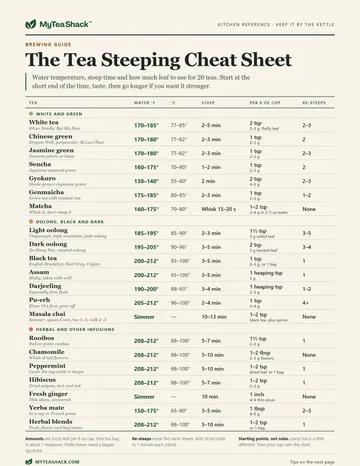
Free printable
The Tea Steeping Cheat Sheet
Water temperature, steep time and how much leaf to use for 20 teas, from sencha to rooibos, on one printable page. Plus five fixes for a bitter cup.